Liam Jin
Course Overview
Chemistry is often called the central science. The subject focuses on materials that make up our physical enviroment. Students study matter, its structure, properties, behaviour, and how it changes in chemical reactions. Our understanding of the world expands through studying matter carefully. It is taught with interesting activities, projects, experiments and real world applications. It plays a major role in our everyday tasks, such as food and cooking, medicine and health, environmental chemistry, cleaning, and household products. It teaches critical thinking, problem solving, and analytical skills. It provides career paths such as healthcare, technology, environment, law, forensics, and research. Foundations for further studies also takes shape.


Chemistry classroom
Content
Grade 8
Students learn that matter is made of tiny particles that are always moving. They learn the states of matter and how matter behaves and changes. They are introduced to atoms, atomic theory basics and explore chemistry using experiments and observations.
Grade 9
Students learn types of matter, mixtures, compounds, and elements. They identify basic chemical reaactions. They learn how the periodic table organises the elements and how it shows patterns in properties. They learn how atoms combine to form ionic and covalent compounds. They use Bohr Diagrams to represent the electron arrangement of atoms.
Grade 10
Students learn chemical reactions and how atoms rearrange and energy changes. They learn acids and bases and their role during reactions. They practice lab skills and learn to use data to explain chemical changes.
Grade 11
Students learn quantum mechanical model and electron configuration, valence electrons and Lewis structures, chemical bonding based on electronegativity, bonds and forces, organic compounds, applivations of organic chemistry, the mole, and more.
Grade 12
Students learn reaction rate, collision theory, reaction mechanism, catalysts, dynamic nature of chemical equilibrium, equilibrium constant, saturated solutions and solubility product, relative strength of acids and bases in solution, and more.

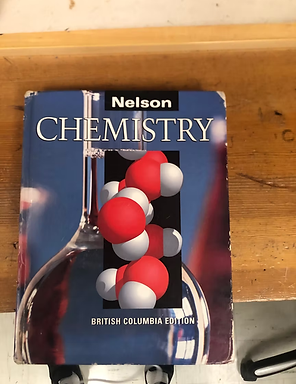
Chemistry textbooks
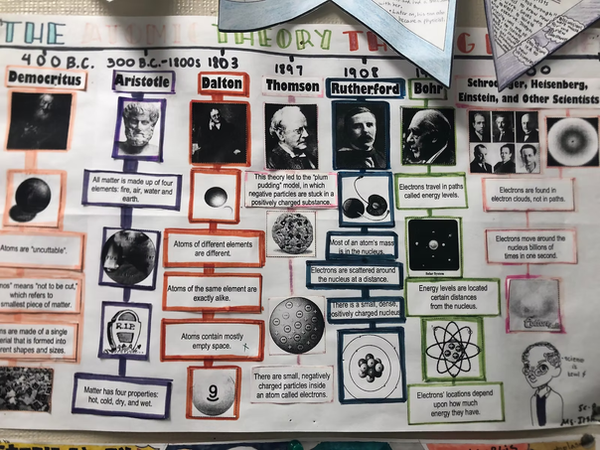
Chemistry poster
Teacher Interview (Ms Chen)
What is the main focus in the chemistry unit?
The chemistry unit will be about Lewis dot structures, as well as bouncing equations. Students are going to be able to predict products whatever their given reactants, very useful in everyday life.
How will the students be safe while working?
We will learn how to use the laboratory safely at the beginning of the unit, how the first day will work, and how to protect each other and work as a team. Then we will do our experiments.
How do you ensure a positive classroom environment?
In our class, people really like science in general. It's always nice to support each other when learning different concepts whether it's partner work, answering questions in class, class discussions, or doing activities together.
How do you handle classroom disruptions or conflicts?
Generally each one is capable of figuring out what they should and should not do in class. But if anyone needs additional support, I usually talk to them later on and then help resolve any disruptions or conflicts.
How do you assess student understanding and provide constructive feedback?
For student understanding, we often do questions and booklets for review. We also use videos to help different types of learners understand the material better. We do quizzes before unit tests just to make sure that everyone is on board. Starting next week, we'll start PLT, which is another great way to come into the class and ask questions.
Describe your approach to building strong relationships with students, parents, and colleagues?
My approach, I would say, is be myself. I like to be myself. With each student, it's nice to know what their interests are, how they are doing overall, what their personailities are. If I ever need to contact parents, it's always a nice and friendly environment to chat.
How do you handle conflicts or disagreements with students or colleagues?
Generally always a respectful point of view. Even if two people disagree with a certain topic, it's always nice to think about things calmly first before approaching the subject, and we try our best to get to the same solution at the end of the discussion.
How would you handle a situation where a student is struggling to understand a chemistry concept?
We will have check-ins during the class to make sure everyone is doing well. If some people are struggling a little bit more, I will recommend they come to PLT so we can have one-on-one conversations and ensure that they feel comfortable and safe and can get the answers they need. If they need more help than that, I will also offer my email for people who want to ask me questions.
Are there any fun activities that students will be interested in?
Yes, of course. We do certain assignments with each other, and some will involve your own life and experiences. We will end the course with the space unit, where students will be able to do personalised projects to further their understanding of space.
What inspired you to become a chemistry teacher?
Chemistry has always been my favourite science. I love all the sciences. Chemistry just happened to be, in my opinion, the best. It's really fun to see students work together to solve a problem and come to a very cool resolution. The excitement that people feel when they finally understand something is so joyous for them and for me. I enjoy building everyday connections with everyone and helping them spot their interests in science.
Conclusion
Often called the central science, chemistry explores the everyday materials we see that make up our physical environment. It is the study of matter, its structure, properties, behaviour, and how it changes in chemical reactions. Through studying materials, our knowledge of the world deepens and science develops. It is usually taught with experiments and real world applications. It helps us in food and cooking, medicine and health, environmental chemistry, cleaning, and household products. It teaches critical thinking, problem solving, and analytical skills. It is used in many fields like healthcare, technology, environment, law, forensics, and research. It also provides foundations for advanced learning.