Liam Jin
English Literary Studies
Course Overview
In English Literary Studies, students read texts in depth, like stories, novels, poems, and plays, and watch films too. They dig into and understand the deep meaning and the complexities. They also learn about history and culture. The course encourages students to listen to different opinions on what they read, develop and swap thoughts, support their personal views with proof, build clear and strong arguments, and consider multiple ways experts see those works.
English literature teaches them critical thinking, because they learn to form and support their own interpretations of texts. It also builds their writing and communication skills, because they have to clearly express their ideas in writing and discussions in class. Students who like reading, writing, and thinking deeply and creatively usually enjoy this subject. It is recommended for students who want to share their views or improve the ability to express themselves.


Poetry analysis

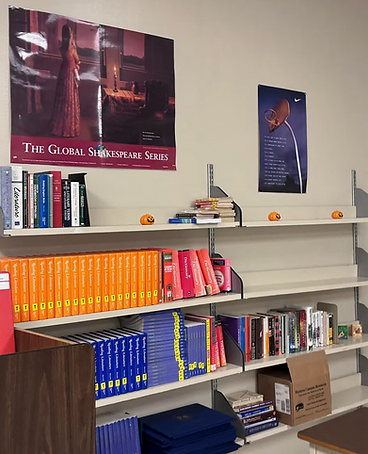
English Literary Studies classroom
Big Ideas
The exploration of text and story deepens our understanding of diverse, complex ideas about identity, others, and the world.
People understand text differently depending on their worldviews and perspectives.
Texts are socially, culturally, geographically, and historically constructed.
Language shapes ideas and influences others.
Questioning what we hear, read, and view contributes to our ability to be educated and engaged citizens.
Types of English Literature
These are the four types of English literature: poetry, fiction, nonfiction, and drama. Besides the general literature genres, there are many subgenres too. Some common subgenres are mystery, fantasy, horror, romance, historical fiction, science fiction, folk lore, and fairy tales.
Poetry
Students will create poems and verses. It is used to evoke feelings and emotions in the text, and to stimulate the creator's imagination with rhythmic metaphors. Poetry and literature prioritise structural form, rhythm, sound, concrete language, emotion and negative impact, as well as differences from prose. The structure of poetry may vary, the format may be very strict, and it can also be in free form. Poems that require a strict format are usually sonnet, villanel, haiku and sestina.
Fiction
Students will use their imagination to explore human experiences. The point of this is to let students learn to imagine and visualise. Novels give priority to writing style, characters and themes, and deeply study the complexities of human behaviour.
Non-fiction
Students will learn how to express and present some real information. They will study true and reliable information and write stories about it. Non-fiction prioritises vivid images, character development, eye-catching narratives, and facts-accurate stories. Non-fiction is used to immerse readers in it and enhance their perspective, just like they are experiencing the story themselves.
Drama
Students improve their ability to express themselves through performance. It prioritises the performance on the stage through dialogue, script form, and stage direction. It is performance-oriented, so in the script, the form of emotion, action or setting is usually highlighted in italics or brackets. Dramatic literature is usually divided into various types. Some of the main drama genres are comedy, which usually prioritises humour and participation. Tragic events in the sequence of tragedy, serious dramas typically have an unhappy ending. Famous examples of literary plays include Shakespeare's Romeo and Juliet, Hamlet, and Macbeth.
History of English Literature
English literature has developed from the 7th century to the present. The main literary works written in English outside the British Isles will be in American literature, Australian literature, Canadian literature and New Zealand literature.
Although British literature was once isolated from the outside world, it has a lot of influence around the world. The Celtic fringe and the rest of the world have also made it richer. From the Anglo-Saxon era to the present, British literature has been evolving not only in England but also in cultural, social and political changes around the world.
Influential writers like William Shakespeare and Jane Austen have made British literature history rich. English has had a great influence on the development of English literature. Between 1350 and 1550, English, Latin and Anglo-Normanic French competed, especially among a few educated people, and because of their diverse dialects, they still faced many challenges.
Between 1350 and 1400, there was a literary and linguistic revolution that made English a literary language. The Elizabethan era was the golden age of British literature. The depth and richness of William Shakespeare's plays were simply eternal. King James version of the Bible in 1611 enriched English and popularised cultural knowledge.
In the 17th and 18th centuries, religious and political conflicts influenced the w poetry from John Dorn to John Milton. The dichotomy of classicism and romanticism dominated in the 18th century, with representative writers Alexander Pope, William Blake and Jane Austen.
In the 19th and 20th centuries, British literature began to pay attention to social issues, and writers such as the Brontë sisters and Charles Dickens had geographical influence. The 20th century saw writers such as Virginia Woolf, T.S. Elliott, and Salman Rushdie.

Teacher Interview (Ms Morit)

What is the most fun thing about English?
The most fun thing about English is that you get to discuss a lot. You get to talk about different ideas, books, movies, and so many interesting topics.
What is the hardest thing about English?
The hardest thing about English is probably grammar, knowing if you made a mistake and how to fix it. Writing essays can also be challenging.
What is the easiest thing about English?
If you just talk a lot, and you love to talk, and like the sound of your own voice, then it's probably going to be a pretty easy course.
What does a typical English lesson in your room look like?
A typical lesson looks like learning about techniques or some sort of common things you see in stories and poetry, and then kind of looking at examples of that.
What novels do you recommend?
For high school, I would probably recommend reading a lot of classic books like Animal Farm, maybe even Shakespeare. I love Shakespeare. But for newer books, I would say The New Yorker is really good, and there are a lot of good dystopian novels.
Why is English such an important subject?
It's important because you use it every day, even after you graduate high school, even if you think you are never going to use it. For example, when you are going to trades, you still have to know how to write in English. You need it to respond to emails and to communicate clearly with others. Even though English involves a lot of reading, it requires a lot of writing too.
Why is English taught in so many foreign countries as a secondary language?
That's a great question. I don't know how much time to unpack colonial history with you, plus the fact that England is probably one of the most strongest countries at the moment. So that's probably my best guess.
What benefits does learning English have compared to other languages?
There are millions and millions of people across the world who speak it. The standard language is English. And so even if you speak another language, English tends to be, in many cases, the standard.
What disadvantages does learning English have compared to other languages?
If you are learning English for a second language or a third language, it's probably one of the hardest languages to learn. It doesn't have a lot of rules. Many languages like Spanish, French, and Japanese have rules. Once you know the rules, it's really easy to learn. When it comes to English, it never really follows its own rules. That's a huge difficulty, at least at learning English.
There are not a lot of disadvantages, I would say. Learning a language is always something that's good for you.
What is the most boring thing about English?
Reading is really boring. I tell my students all the time, you get to choose what you read, find something you love to read. People say they don't read. That's not true. You read every day. You just don't read things you like to read.
Conclusion
English Literary Studies is a subject where students read or watch various literary works like stories, novels, poems, plays, and films. Instead of just reading, they dig into layers behind words through different kinds of writing, including poetry, fiction, nonfiction, and drama. English literature has a long and rich history, produced from the 7th century. Learning English matters because we use it every day to communicate with others and handle messages and emails. A lot of people worldwide use it, no matter their country. This course helps students think deeper when getting better at talking and putting words on paper. If you want to develop these skills, or you like reading and discussing your ideas and opinions, studying English literature is definitely a good choice.